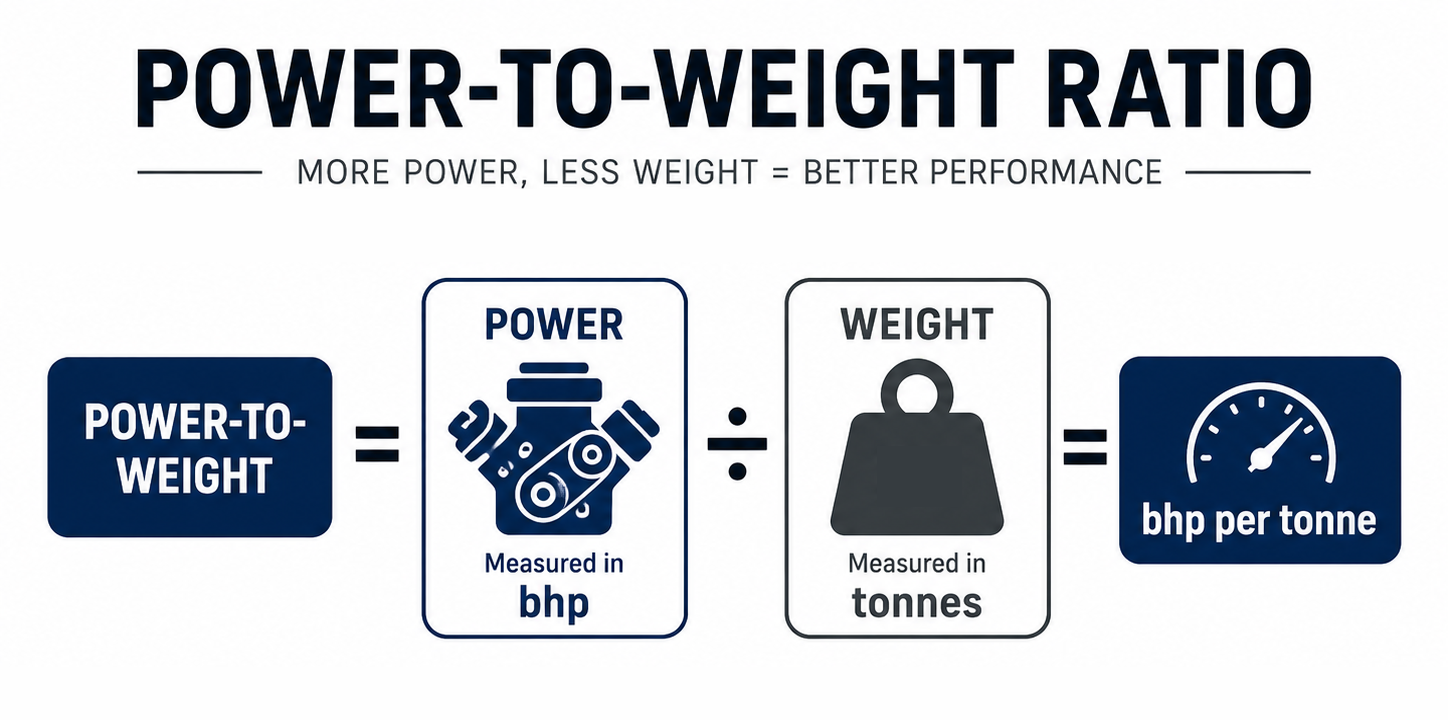
Power-to-weight ratio is one of the clearest ways to cut through the noise of headline performance figures. Peak power alone tells only half the story; what matters is how much mass that power has to move. A car with 300bhp and a lean kerb weight can feel sharper, more urgent and more exploitable than a heavier machine with a larger number on the spec sheet. It is the relationship between output and weight that helps explain why some cars punch above their class, while others never quite feel as fast as their power figure suggests.
The principle is simple: the less weight each horsepower has to carry, the more effectively the car can accelerate, respond and change direction. A strong power-to-weight ratio usually translates into better straight-line performance, but its influence goes further than the sprint to 60mph. Lower mass benefits braking, cornering, tyre load, throttle response and overall agility. It is why lightweight performance cars often feel so vivid and connected, and why the best drivers’ cars are rarely defined by power alone. In a meaningful performance comparison, power-to-weight ratio is not just another statistic; it is often the figure that reveals the car’s true intent.
| Rank | Model | Origin | Fuel | Drive | Power-to-weightbhp/tonne | PowerPS | Weightkg | 0-62 mphsec | Top speedmph | MPG | CO2g/km | Insurancegroup |
|---|---|---|---|---|---|---|---|---|---|---|---|---|
| 1 | Kia EV6 GT (CV) | 288.7 | 650 | 2,220 | 3.5 | 161 | – | 0 | 46E | |||
| 2 | Hyundai IONIQ 5 N (NE) | 286.8 | 650 | 2,235 | 3.5 | 162 | – | 0 | 49 | |||
| 3 | Mini John Cooper Works GP (2020) | 240.6 | 306 | 1,255 | 5.2 | 164 | 32.0 | 167 | 37 | |||
| 4 | MG4 XPower | 240.3 | 435 | 1,785 | 3.8 | 124 | – | 0 | 40E | |||
| 5 | Mercedes-Benz A45 AMG (W176) | 239.9 | 360 | 1,480 | 4.5 | 155 | 40.0 | 161 | 43 | |||
| 6 | Ford Focus RS Heritage Edition (2018) | 235.8 | 375 | 1,569 | 4.5 | 165 | 36.0 | 175 | 40 | |||
| 7 | Cupra Leon VZ (KL) | 225.1 | 325 | 1,426 | 5.4 | 168 | 33.0 | 184 | 30 | |||
| 8 | Ford Focus RS (2016) | 219.9 | 350 | 1,569 | 4.7 | 165 | 36.0 | 175 | 40 | |||
| 9 | Audi S3 Manual (8V) | 212.2 | 300 | 1,395 | 5.2 | 155 | 40.0 | 162 | 36 | |||
| 10 | BMW M135i (F21) | 211.2 | 324 | 1,515 | 5.1 | 155 | 37.0 | 175 | – | |||
| 11 | Audi S3 S Tronic(8V) | 209.2 | 300 | 1,415 | 4.8 | 155 | 40.0 | 159 | 36 | |||
| 12 | BMW M135i xDrive (F40) | 198.0 | 306 | 1,525 | 4.8 | 155 | 35.0 | 155 | 36 | |||
| 13 | Ford Fiesta ST200 (2016) | 194.9 | 215 | 1,088 | 6.7 | 143 | 46.0 | 140 | 31 | |||
| 14 | Hyundai i30 N Performance Manual (PD) | 193.1 | 280 | 1,429 | 5.9 | 155 | 34.0 | 191 | 28 | |||
| 15 | Ford Focus ST (C519) | 192.3 | 280 | 1,435 | 5.7 | 155 | 34.0 | 183 | 34 | |||
| 16 | Mini John Cooper Works Manual (2015) | 188.9 | 231 | 1,207 | 6.3 | 153 | 35.0 | 155 | 29E | |||
| 17 | Vauxhall Astra VXR (2012) | 187.1 | 280 | 1,475 | 6.1 | 155 | 34.0 | 189 | 35 | |||
| 18 | Mini John Cooper Works F56 automatic | 186.3 | 231 | 1,224 | 6.1 | 153 | 41.0 | 133 | 29E | |||
| 19 | Hyundai i30 N Performance DCT (PD) | 183.5 | 280 | 1,504 | 5.4 | 155 | 35.0 | 182 | 28 | |||
| 20 | Alfa Romeo 147 GTA | 181.6 | 250 | 1,360 | 6.3 | 153 | 23.0 | 287 | 36E | |||
| 21 | Renault Clio V6 Phase 2 (2003) | 180.0 | 255 | 1,400 | 5.9 | 153 | 23.0 | 285 | 39 | |||
| 22 | Renault Megane Renaultsport 250 Cup (X95) | 178.1 | 250 | 1,387 | 6.1 | 156 | 33.0 | 195 | 34 | |||
| 23 | MINI John Cooper Works GP (2013) | 176.5 | 220 | 1,235 | 6.3 | 155 | 39.0 | 165 | 40 | |||
| 24 | Volkswagen Golf R Manual (2009) | 173.9 | 270 | 1,530 | 5.7 | 155 | 33.0 | 199 | 36 | |||
| 25 | Volkswagen Golf R DSG (2009) | 173.9 | 270 | 1,530 | 5.7 | 155 | 33.0 | 195 | 37 |